Abstract base class for sensor data capture (cameras, lidars, etc.) More...
#include <SensorCapture.h>
Public Member Functions | |
| virtual | ~SensorCapture () |
| Virtual destructor. | |
| SensorData | takeData (SensorCaptureInfo *info=0) |
| Captures sensor data with frame rate control. | |
| virtual bool | init (const std::string &calibrationFolder=".", const std::string &cameraName="")=0 |
| Initializes the sensor. | |
| virtual std::string | getSerial () const =0 |
| Returns the sensor's serial number or unique identifier. | |
| virtual bool | odomProvided () const |
| Checks if the sensor provides odometry poses. | |
| virtual bool | getPose (double stamp, Transform &pose, cv::Mat &covariance, double maxWaitTime=0.06) |
| Gets the sensor's pose estimate at a specific timestamp. | |
| float | getFrameRate () const |
| Returns the target frame rate. | |
| const Transform & | getLocalTransform () const |
| Returns the local transform from base frame to sensor frame. | |
| void | setFrameRate (float frameRate) |
| Sets the target frame rate. | |
| void | setLocalTransform (const Transform &localTransform) |
| Sets the local transform from base frame to sensor frame. | |
| void | resetTimer () |
| Resets the frame rate timer. | |
Protected Member Functions | |
| SensorCapture (float frameRate=0, const Transform &localTransform=Transform::getIdentity()) | |
| Protected constructor. | |
| virtual SensorData | captureData (SensorCaptureInfo *info=0)=0 |
| Pure virtual method to capture sensor data. | |
| int | getNextSeqID () |
| Gets the next sequence ID. | |
Detailed Description
Abstract base class for sensor data capture (cameras, lidars, etc.)
SensorCapture provides a unified interface for capturing sensor data from various sensor types including cameras (RGB-D, stereo, mono) and lidars. It handles frame rate control, local transform management, and provides a common API for sensor initialization and data capture.
The class implements the Template Method pattern:
takeData()handles frame rate control and timing, then calls the pure virtualcaptureData()method implemented by derived classes- Derived classes must implement
captureData()to perform the actual sensor capture
Key features:
- Frame rate control: Automatic throttling to maintain target frame rate
- Local transform: Transform from robot base frame to sensor frame
- Capture timing: Tracks capture time and provides it via SensorCaptureInfo
- Sequence IDs: Automatic sequence number generation for captured data
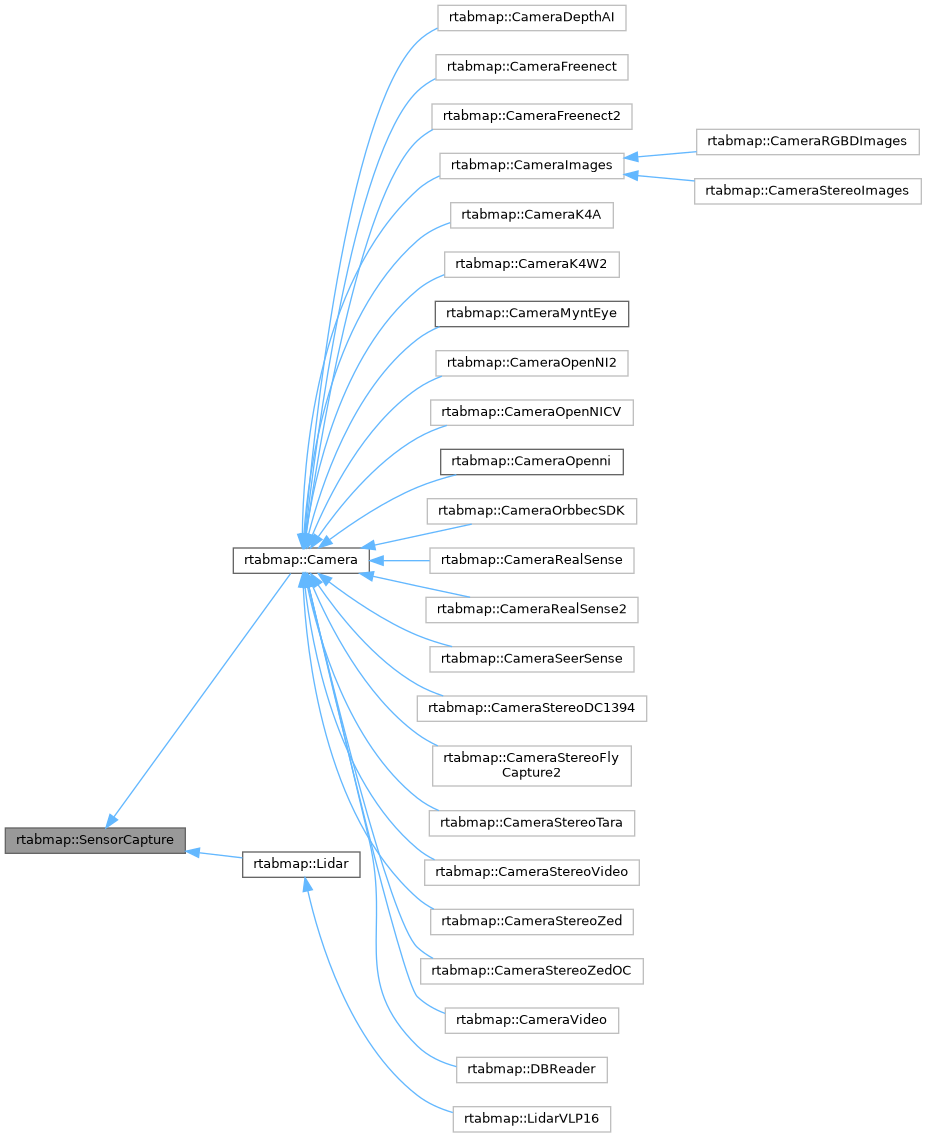
Derived classes include:
- Camera: Base class for all camera types (RGB-D, stereo, mono, file readers, etc.)
- Lidar: Base class for lidar sensors
- Note
- This is an abstract class. Use concrete implementations like CameraRGBD, CameraStereo, LidarVLP16, etc., or create custom derived classes.
Definition at line 78 of file SensorCapture.h.
Constructor & Destructor Documentation
◆ SensorCapture()
|
protected |
Protected constructor.
Creates a SensorCapture instance with the specified frame rate and local transform. This constructor is protected because SensorCapture is an abstract base class and should not be instantiated directly.
- Parameters
-
frameRate Target frame rate in Hz (0 = unlimited, capture as fast as possible) localTransform Transform from base frame to sensor frame (default: identity)
Member Function Documentation
◆ takeData()
| SensorData rtabmap::SensorCapture::takeData | ( | SensorCaptureInfo * | info = 0 | ) |
Captures sensor data with frame rate control.
This method handles frame rate throttling and timing, then calls the pure virtual captureData() method to perform the actual capture.
The method:
- Enforces the target frame rate by sleeping if necessary
- Measures capture time and stores it in SensorCaptureInfo
- Assigns sequence IDs to captured data
- Warns if the target frame rate cannot be reached
- Parameters
-
info Optional pointer to SensorCaptureInfo to fill with capture metadata (ID, timestamp, capture time). If null, no info is filled.
- Returns
- SensorData containing the captured sensor data
- Note
- If frame rate is 0, data is captured as fast as possible without throttling.
- The returned SensorData should have rectified images if calibration was loaded.
- See also
- captureData()
◆ init()
|
pure virtual |
Initializes the sensor.
Pure virtual method that must be implemented by derived classes to initialize the sensor hardware or data source. This typically involves:
- Opening device connections or file streams
- Loading camera calibration parameters
- Configuring sensor settings
- Parameters
-
calibrationFolder Directory path where calibration files are located (default: current directory ".") cameraName Base name of the camera for loading calibration files (default: empty string)
- Returns
- True if initialization was successful, false otherwise
- Note
- Must be called before calling takeData() or captureData()
Implemented in rtabmap::CameraDepthAI, rtabmap::CameraFreenect, rtabmap::CameraFreenect2, rtabmap::CameraImages, rtabmap::CameraK4A, rtabmap::CameraK4W2, rtabmap::CameraMyntEye, rtabmap::CameraOpenni, rtabmap::CameraOpenNI2, rtabmap::CameraOpenNICV, rtabmap::CameraOrbbecSDK, rtabmap::CameraRealSense, rtabmap::CameraRealSense2, rtabmap::CameraRGBDImages, rtabmap::CameraSeerSense, rtabmap::CameraStereoDC1394, rtabmap::CameraStereoFlyCapture2, rtabmap::CameraStereoImages, rtabmap::CameraStereoTara, rtabmap::CameraStereoVideo, rtabmap::CameraStereoZed, rtabmap::CameraStereoZedOC, rtabmap::CameraVideo, rtabmap::DBReader, and rtabmap::LidarVLP16.
◆ getSerial()
|
pure virtual |
Returns the sensor's serial number or unique identifier.
Pure virtual method that must be implemented by derived classes to return a unique identifier for the sensor (e.g., device serial number, file path, or other identifier).
- Returns
- String identifier for the sensor
Implemented in rtabmap::CameraDepthAI, rtabmap::CameraFreenect, rtabmap::CameraFreenect2, rtabmap::CameraImages, rtabmap::CameraK4A, rtabmap::CameraK4W2, rtabmap::CameraMyntEye, rtabmap::CameraOpenni, rtabmap::CameraOpenNI2, rtabmap::CameraOpenNICV, rtabmap::CameraOrbbecSDK, rtabmap::CameraRealSense, rtabmap::CameraRealSense2, rtabmap::CameraSeerSense, rtabmap::CameraStereoDC1394, rtabmap::CameraStereoFlyCapture2, rtabmap::CameraStereoImages, rtabmap::CameraStereoTara, rtabmap::CameraStereoVideo, rtabmap::CameraStereoZed, rtabmap::CameraStereoZedOC, rtabmap::CameraVideo, rtabmap::DBReader, and rtabmap::LidarVLP16.
◆ odomProvided()
|
inlinevirtual |
Checks if the sensor provides odometry poses.
Some sensors (e.g., visual-inertial cameras) can provide pose estimates directly. This method indicates whether the sensor supports pose queries.
- Returns
- True if the sensor provides odometry poses, false otherwise
- Note
- Default implementation returns false. Derived classes should override if they support pose estimation.
- See also
- getPose()
Reimplemented in rtabmap::CameraImages, rtabmap::CameraMyntEye, rtabmap::CameraRealSense, rtabmap::CameraRealSense2, rtabmap::CameraSeerSense, rtabmap::CameraStereoZed, and rtabmap::DBReader.
Definition at line 152 of file SensorCapture.h.
◆ getPose()
|
inlinevirtual |
Gets the sensor's pose estimate at a specific timestamp.
Queries the sensor for its pose estimate at the given timestamp. This is typically used for sensors that provide visual-inertial odometry or other pose estimation capabilities.
- Parameters
-
stamp Timestamp in seconds for which to query the pose [out] pose Output transform representing the sensor pose [out] covariance Output covariance matrix (6x6) representing twist uncertainty maxWaitTime Maximum time in seconds to wait for pose data (default: 0.06)
- Returns
- True if pose was successfully retrieved, false otherwise
- Note
- Default implementation returns false. Derived classes should override if they support pose estimation.
- See also
- odomProvided()
Reimplemented in rtabmap::CameraSeerSense, rtabmap::CameraStereoZed, rtabmap::CameraRealSense2, and rtabmap::DBReader.
Definition at line 172 of file SensorCapture.h.
◆ getFrameRate()
|
inline |
Returns the target frame rate.
- Returns
- Frame rate in Hz (0 = unlimited, capture as fast as possible)
Definition at line 180 of file SensorCapture.h.
◆ getLocalTransform()
|
inline |
Returns the local transform from base frame to sensor frame.
- Returns
- Const reference to the local transform
Definition at line 186 of file SensorCapture.h.
◆ setFrameRate()
|
inline |
Sets the target frame rate.
Controls how often takeData() will capture data. The method will throttle captures to maintain the target rate.
- Parameters
-
frameRate Target frame rate in Hz (0 = unlimited, capture as fast as possible)
- Note
- Setting frame rate to 0 disables throttling and captures as fast as possible.
Definition at line 200 of file SensorCapture.h.
◆ setLocalTransform()
|
inline |
Sets the local transform from base frame to sensor frame.
The local transform represents the pose of the sensor relative to the robot's base frame. This is used to transform sensor data into the robot's coordinate system.
- Parameters
-
localTransform Transform from base frame to sensor frame
Definition at line 210 of file SensorCapture.h.
◆ resetTimer()
| void rtabmap::SensorCapture::resetTimer | ( | ) |
Resets the frame rate timer.
Resets the internal timer used for frame rate control. This is useful when starting a new capture session or after a pause.
◆ captureData()
|
protectedpure virtual |
Pure virtual method to capture sensor data.
This method must be implemented by derived classes to perform the actual sensor data capture. It is called by takeData() after frame rate throttling.
The returned SensorData should:
- Have rectified images if calibration was loaded during
init() - Include proper timestamps
- Contain valid sensor data (images, depth, laser scans, etc.)
- Parameters
-
info Optional pointer to SensorCaptureInfo to fill with capture metadata. The base class will fill ID, timestamp, and capture time, but derived classes can add additional information.
- Returns
- SensorData containing the captured sensor data
- Note
- If capture fails, return an empty SensorData (id=0, stamp=0.0).
- RGB and depth images should be already rectified if calibration was loaded.
- See also
- takeData()
Implemented in rtabmap::LidarVLP16.
◆ getNextSeqID()
|
inlineprotected |
Gets the next sequence ID.
Returns and increments the internal sequence counter. This is used to assign unique sequence numbers to captured data.
- Returns
- Next sequence ID (starts at 1, increments with each call)
Definition at line 264 of file SensorCapture.h.
The documentation for this class was generated from the following file:
- corelib/include/rtabmap/core/SensorCapture.h